
Worse than Nuclear Meltdown – In a report prepared for the UN Japan says they believe that Fukushima fuel rods have melted through the bottom for three reactors.
The Montreal Gazette reports that Japan has prepared a report for the UN nuclear watchdog — the IAEA — which states they believe molten nuclear lava at the Fukushima nuclear reactor has melted through the bottom of the containment vessels.
Japan to report nuclear ‘melt-throughs’ to UN
France Ecology, Transport and Housing Minister Nathalie Kosciusko-Morizet (R) and Hideichi Okada, Vice Minister for International Affairs of the Ministry of Economics, Trade and Industry of Japan, attend a ministerial seminar on nuclear safety at the Organization for Economic Co-operation and Development (OECD) headquarters in Paris June 7, 2011.
TOKYO – Japan in a report prepared for the UN nuclear watchdog on Tuesday said for the first time that fuel in its crippled Fukushima plant may have melted through three reactor core vessels.
[…]
Prime Minister Naoto Kan, approving the 750-page report, said that “above all, it is most important to inform the international community with thorough transparency in order for us to regain its confidence in Japan.”
Japan is due to submit the report to the UN International Atomic Energy Agency (IAEA), which sent its own multinational fact-finding team to Japan and is due to discuss the disaster at its Vienna headquarters this month.
Japan’s Nuclear and Industrial Safety Agency (NISA) now says it believes 770,000 terabecquerels escaped into the atmosphere in the first six days — compared to its earlier estimate of 370,000 terabecquerels.
NISA’s revised radiation figure is likely to fuel criticism of the initially slow and vague flow of information from the Kan government and embattled plant operator Tokyo Electric Power Company (TEPCO).
[…]
NISA also said in its review that it believes much of the nuclear fuel inside three reactors melted down faster than previously believed.
TEPCO has said it believes the molten fuel is now being cooled by water at the bottom of the number one, two and three reactors, citing the relatively low outside temperatures of the containers.
In its report, Japan’s government informs the IAEA that fuel is assumed to have melted down and may have burnt through the reactor pressure vessels of units one, two and three and into their outer steel containment vessels.
[…]
Meanwhile, frantic efforts continued at the plant to meet TEPCO’s stated deadline of bringing all six reactors at Fukushima Daiichi to a stable state of “cold shutdown” some time between October and January.
Months of hosing operations have left more than 100,000 tonnes of highly radioactive water in buildings, basements and ditches at the plant, and TEPCO is struggling to remove the runoff so it can resume crucial repair work.
Contaminated water has spilled or been released several times into the Pacific Ocean, and environmental group Greenpeace has warned that it has found unsafe radiation levels in marine species as far as 50 kilometres (30 miles) offshore.
[…]
Source: Montreal Gazette
A few things stand out in this report. First of all going by Russia’s estimates, the newly revised increase in radiation release estimates put the amount released in just the first few days at 60% of the total amount released from Chernobyl. Keep in mind that was only over the first few days and this disaster is now nearing the 3 month mark.
The report also refers to a so-called independent study conducted by the IAEA. A review of the IAEA report clearly show little fact-finding instead the agency focuses on minimizing the dangers of the disaster and was entirely meant “to suppress discussion and protect the nuclear industry from scrutiny”.
IAEA whitewashes worst nuclear disaster since Chernobyl
By William Whitlow
4 June 2011On June 1, the International Atomic Energy Agency (IAEA) issued a preliminary report on the Fukushima nuclear disaster. The report is a whitewash, exonerating the Tokyo Electrical Power Company (TEPCO) and the Japanese government of blame. Its bland language is an attempt to suppress discussion and protect the nuclear industry from scrutiny.
The report comes as two more workers at the plant were found to have exceeded maximum doses of radiation. Two male workers, one in his 30s and the other in his 40s, have been exposed to more than the 250 millisieverts level legally allowed for nuclear workers in Japan. The government raised the limit from its previous level of 100 millisieverts after the disaster. Exposure to more than 100 millisieverts of radiation is thought to increase the lifetime risk of developing cancers.
Previously, three workers were found to have been exposed to over 1000 millisieverts after working in flooded tunnels under the Fukushima plant. This new revelation points once again to the dangers faced by workers on the site. The full extent of the workforce’s exposure to radiation is not known. Workers involved in the recovery operations are still not subject to routine testing. Some 7,800 workers have been employed at Fukushima since the disaster, but only 1,800 have been checked for radiation exposure, according to the newspaper Asahi Shimbun.
[…]
From Nuclear Meltdown To Nuclear Melt-Through
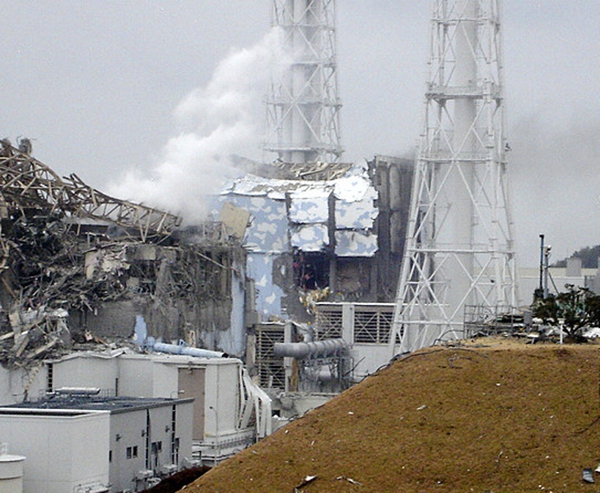
Nuclear Meltdown At The Fukushima Reactor In Japan
Here is a brief, layman’s explanation of what officials are now finally admitting may have happened at the Fukushima nuclear reactor. You can read the much more detailed article at the link below.

The anatomy of a nuclear meltdown
Anatomy of Japan’s Nuclear Plant Meltdown
In the 1979 movie “The China Syndrome” a nuclear reactor experiences a meltdown of it’s core.
In this hypothetical scenario, nuclear material located within a containment building reaches a temperature beyond a manageable capacity. As the temperatures increase, the reactor melts and burns through the foundation of the power plant and into the crust of the earth.
The idea behind the term “China Syndrome” is that once the nuclear material generates heat beyond 4,000 degrees Fahrenheit, it could continue to burn itself all the way through the earth, to the other side of the planet, stopping at China.
The Fukushima Daiichi Nuclear Power Plant in Japan has 6 “Boiling Water” reactors that were completed in the late 70′s. In fact, the plant that has reached a critical place of possible meltdown was designed by the United States.
The basic structure of the facility in which the nuclear material is housed, is encased in a core of six-inch thick solid stainless steel containment structure that is pill-shaped. Inside this structure are several hundred fuel rods assemblies. Each Assembly has about one hundred fuel rods constructed of Zirconium Alloy. These fuel rods have within them, pellets of Uranium that have been enriched from three to five percent of the energy producing U-235 Isotope.
The following description and illustrations depict what happened so far at Fukushima, and what we may expect to happen in the future:
The Fukushima Nuclear power plant in Japan uses a facility called a “Boiling Water Reactor”. (1) Two thirds of the reactor is filled with water. (2) Below the water is a section of Nuclear fuel rods made from Uranium. (3) As the Uranium fuel rods generate heat, water begins to boil and produces steam that is piped into a turbine that is spun. (4) Electricity is generated.
When the earthquake hit power to the plant was cutoff and the reactors could no longer be cooled.
The lack of electricity cause the reactors to over heat, boiling off the water inside.
Within hours the temperatures shot up to 4,000 degrees melting the protective coating off the fuel rods
The super heated fuel became so hot it melted through the bottom of the reactors.


